

Study in Ireland
Your Dream Starts Here
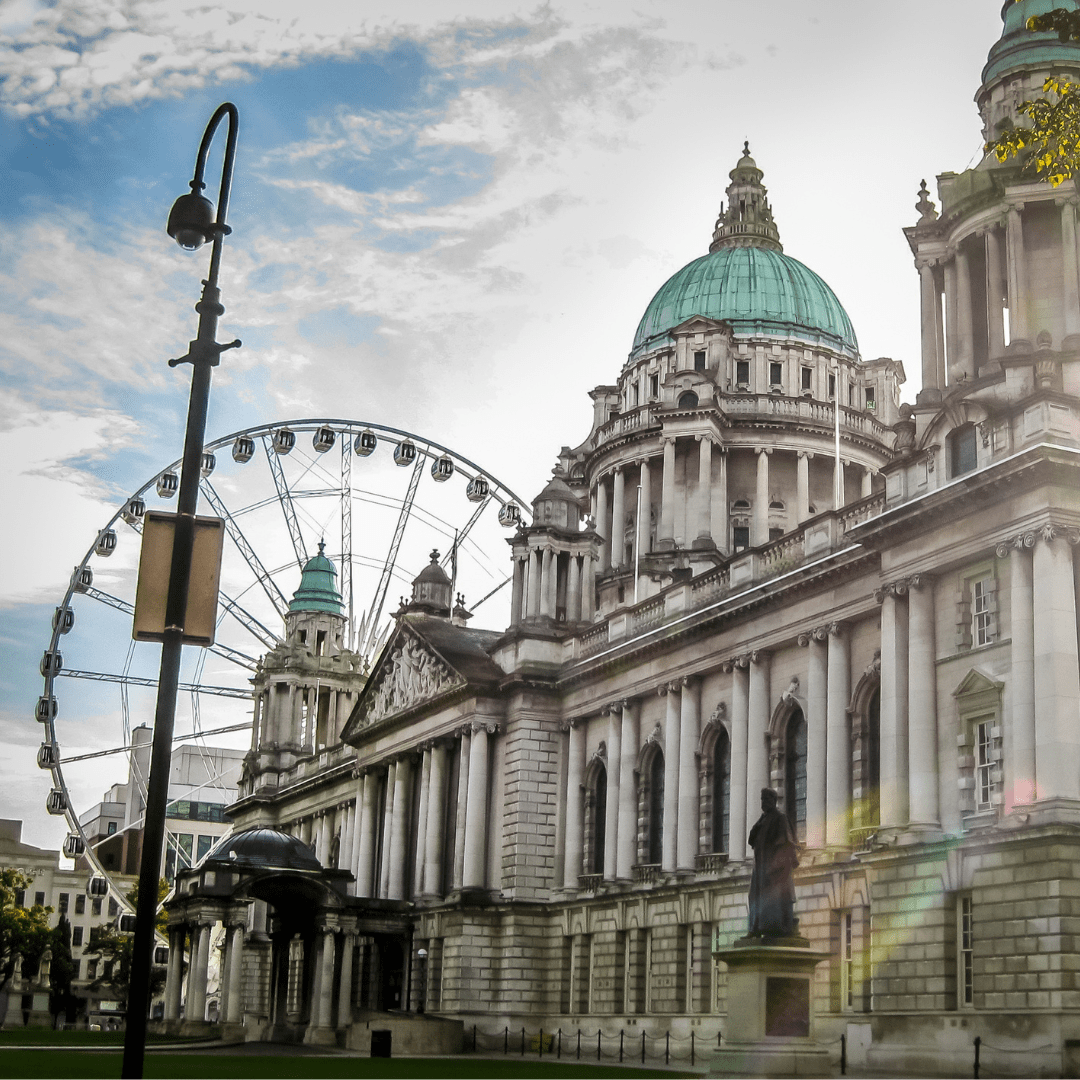


Ireland, known for its vibrant culture and welcoming atmosphere, ranks highly among the world’s most desirable study destinations. The country offers a unique blend of rich history, stunning landscapes, and a high standard of living. Irish universities are celebrated for their excellent academic programs and research opportunities, often at more affordable tuition rates compared to other Western countries. This combination of quality education and reasonable costs makes Ireland an appealing choice for international students.
1. Location: Ireland is an island in the North Atlantic, located to the west of Great Britain.
2. Capital: Dublin is the capital and largest city of Ireland.
3. Language: The official languages are Irish (Gaelic) and English. English is the most widely spoken language, while Irish is spoken mainly in certain regions known as the Gaeltacht.
4. Population: Ireland has a population of approximately 5 million people (as of 2023).
5. Government: Ireland is a parliamentary democracy with a president as the head of state and a prime minister (Taoiseach) as the head of government.
6. Currency: The euro (€) is the official currency.
7. Independence: Ireland gained independence from the United Kingdom in 1922, following the Anglo-Irish Treaty. It became a republic in 1949.
8. Geography: The island of Ireland is divided into two parts: the Republic of Ireland, which occupies most of the island, and Northern Ireland, which is part of the United Kingdom.
9. Economy: Ireland has a modern, high-tech economy with strong sectors in pharmaceuticals, technology, and finance. It is known for being a major hub for multinational companies in Europe.
10. Famous Landmarks:
– Cliffs of Moher: Stunning sea cliffs on the western coast.
– Giant’s Causeway: Famous basalt columns located in Northern Ireland.
– Blarney Castle: Home to the legendary Blarney Stone.
11. Culture: Ireland is known for its rich cultural heritage, including traditional Irish music, dance (like Riverdance), and literature. It has produced many famous writers, including James Joyce, W.B. Yeats, and Samuel Beckett.
12. National Day: St. Patrick’s Day, celebrated on March 17th, is Ireland’s national holiday and is recognized worldwide.
13. Sports: Popular sports include Gaelic football, hurling, rugby, and soccer.
14. Climate: Ireland has a temperate maritime climate, characterized by mild winters, cool summers, and frequent rainfall.
The education system in Ireland, both in the Republic of Ireland and Northern Ireland (which is part of the UK), is structured to provide education from early years through to higher education. Here’s an overview of the education systems in both areas:
1. Education System in the Republic of Ireland
A. Early Childhood Education:
– Ages: Birth to 6 years old.
– Types: Includes preschool and early childhood care and education (ECCE) programs. The ECCE scheme provides free preschool education for children from age 2.5 to 5.5 years old.
B. Primary Education:
– Ages: 4 to 12 years old.
– Levels:
– Junior Infants: Typically for children aged 4-5.
– Senior Infants: Typically for children aged 5-6.
– First Class to Sixth Class: Typically for children aged 6-12.
– Curriculum: Core subjects include English, Irish, mathematics, and social, environmental, and scientific education (SESE). Art, music, and physical education are also included.
C. Post-Primary Education:
– Ages: 12 to 18 years old.
– Levels:
– Junior Cycle: Years 1 to 3 (ages 12-15). Students take the Junior Certificate (JC) exams at the end of this cycle.
– Senior Cycle: Years 4 to 6 (ages 15-18). Students take the Leaving Certificate (LC) exams at the end of this cycle. The Leaving Certificate is a critical examination for university and college entry.
– Types of Schools: Includes traditional secondary schools, vocational schools, and community schools.
D. Higher Education:
– Types: Includes universities, institutes of technology, and private colleges.
– Degrees:
– Undergraduate Degrees: Typically 3 to 4 years (e.g., Bachelor’s degrees).
– Postgraduate Degrees: Includes Master’s degrees (typically 1 year) and Doctoral degrees (PhD, usually 3-4 years).
E. Further Education and Training:
– Includes: Post-secondary vocational training, adult education, and community education. This includes further education colleges and training programs.
2. Education System in Northern Ireland
A. Early Years Education:
– Ages: Birth to 6 years old.
– Types: Includes nursery schools, primary school nursery units, and pre-school playgroups. The Pre-School Education Expansion Programme (PSEEP) provides funded places for children in their final pre-school year.
B. Primary Education:
– Ages: 4 to 11 years old.
– Levels:
– Foundation Stage: Years 1 and 2 (ages 4-6).
– Key Stage 1: Years 3 and 4 (ages 6-8).
– Key Stage 2: Years 5 to 7 (ages 8-11).
– Curriculum: Core subjects include English, mathematics, Irish (in Irish-medium schools), science, and the arts. Physical education and religious education are also included.
C. Post-Primary Education:
– Ages: 11 to 16 years old.
– Levels:
– Key Stage 3: Years 8 to 10 (ages 11-14).
– Key Stage 4: Years 11 and 12 (ages 14-16). Students take General Certificate of Secondary Education (GCSE) exams at the end of Key Stage 4.
– Types of Schools: Includes grammar schools, secondary schools, and integrated schools.
D. Post-16 Education:
– Ages: 16 to 18 years old.
– Options:
– Sixth Form: In grammar schools or colleges, where students typically pursue A-levels or vocational qualifications like BTECs.
– Further Education Colleges: Provide a range of academic and vocational courses, including apprenticeships.
E. Higher Education:
– Types: Includes universities and higher education colleges.
– Degrees:
– Undergraduate Degrees: Typically 3 years (e.g., Bachelor’s degrees).
– Postgraduate Degrees: Includes Master’s degrees and Doctoral degrees.
F. Further Education and Training:
– Includes vocational training, adult education, and lifelong learning opportunities.
Key Differences:
– Curriculum: The Republic of Ireland emphasizes the Irish language as a core subject, while Northern Ireland follows the UK National Curriculum with a focus on English and other core subjects.
– Exams: The Republic of Ireland uses the Junior Certificate and Leaving Certificate, while Northern Ireland uses GCSEs and A-levels.
– Governance: Education in the Republic of Ireland is overseen by the Department of Education and Skills, while education in Northern Ireland is overseen by the Department of Education.
Both systems aim to provide a comprehensive education that prepares students for further education or the workforce, with a focus on academic and vocational skills.
Offer letter
- Complete your application form
- Academic documents till date
- IELTS/TOEFL Score (5.5 is minimum requirement. However, it might be different as per the College, University and the level of course)
- Passport
- Work Experience (If any)
- Statement of propose
- Offer letter time 1 to 2 weeks
Visa Documentation
- Printed & Signed summary form online application. All applicants must be lodged online – see www.embassyofireland.in for details
All questions on the online application form should be answered. Failure to do this will result in your application being refused.
- Additional Student visa application form and questionnaire. No Duplicates required.
- Original passport valid for at least 6 months after the intended date of departure from Ireland following visits. A full copy of all pages of this passport should be submitted.
- One recent passport sized color photographs not more than 6 months old. Photograph should be 45-50mm in height and 35-38mm in width. It should show a close up of your face and the top of your shoulders so that your face takes up 70-80% of the frame.
- You should submit all previous passports along with a photocopy of each page of all the passport(s) submitted. If you have been refused a visa for any other country, details of this, preferably the original letter issued to you by the authorities of that country, should be submitted. Concealment of other visa refusals will result in your Irish visa application being refused.
- The required visa fee (Single Entry- 4300 IC, Multiple Entry-7100 IC) in the form of DD in favor of “Embassy of Ireland, New Delhi”. VFS Service charge NPR 3040 per applicant. To be paid in Bank Draft only at the time of application submission.
- An up to date police clearance certificate
Original plus one copy for each of the following documents:
- Acceptance letter & Confirmation of fees paid – – this is not necessary for those courses listed for “Approval in Principal”. Course commencement date ………………………………. Agent Name: ………………………………………
If you do not supply your agent name this will be considered as an attempt to mislead the Visa Official and your application will be refused. This will also be reported to the Educational Institute in Ireland.
- Details of the family members residing in Ireland or any European country.
- Statement of Purpose
- Brief CV
- Certificate of Educational Qualifications.
a) Class 10th Mark-Sheet & Charecter Certificate
b) Class 12th Transcript, Provisional & Charecter Certificate
c) Bachelor Transcript, Provisonal, Charecter Certificate
d) Work Experience (if any. Only a letter from student’s current employer should be submitted. Any other recommendation letters should not be submitted.
- Evidence of the adequate level of English e.g. IELTS,TOEFL( IELTS should be minimum 5.5)
- Affidavit of support:
Relationship with the sponsor (1):———————–
Relationship with the sponsor (2):———————–
Relationship with the sponsor (3):————————
- Financial documents:A) Bank Statement & Bank certificate (Last 6 months)
B) Educational loan paper (if any)
C) CA Statement
D) Evaluation report
E) Income tax return papers
- Documents pertaining to property deeds, NSC’s, KVP’s, Mutual funds should not be collected at all & will not be accepted by the embassy also- a chartered accountant’s statement incorporating the value of above property /funds will suffice.
- Fixed deposit receipts should not be submitted. A statement from the bank (Bank letter head) giving the total value of the deposit will suffice.
- There has to be land lined contact no. in the letter head of any documents that submitted for the visa application support. Mobile no. is not accepted for any inquires.
Please supply full contact details for all your sponsors. If they are not directly related to you, eg: Mother/Father/Sibling, please explain the relationship and provide some evidence of this. If your sponsors are unrelated to you please give some explanation as to why they are undertaking to sponsor your education in Ireland.
PROVIDE A PHOTOCOPY OF ALL DOCUMENTS YOU WISH TO HAVE RETURNED TO YOU.
ALL DOCUMENTATION MUST BE IN ENGLISH OR ACCOMPANIED BY A NOTARISED TRANSLATION.
A VISA OFFICER MAY REQUIRE FURTHER DOCUMENTATION IF HE OR SHE DEEMS IT NECESSARY, BEFORE THEY CAN MAKE A DECISION ON AN APPLICATION.
APPLICATIONS DEALT WITH BY THE VISA OFFICE NEW DELHI MAY TAKE UP TO 4WEEKS TO PROCESS IF ALL DOCUMENTATION IS IN ORDER.
- Source: Click Here
Dependent
Normally not but there has got some provision to invite as per this web source: Click Here
Visa Type
Student
Method of teaching
English
Interview
Telephonic interview may be taken by case officer
Intakes
Intakes:Monstly January and September each year but flexible intakes also may available depending upon the colleges
Expenses
- Tuition Fee payable for 1year (5000EURO to 12000EURO depending in the College, University & Level of course)
- Pocket money (7000 Euro)/year
- Air Ticket (500 Euro) Approx.
- Visa fee: Approximate expenses might be 10 to 12 lakhs all together
Key Facts
- Ireland is an island to the north-west of continental Europe. It is the third-largest island in Europe and the twentieth-largest island on Earth. To its east is the larger island of Great Britain, from which it is separated by the Irish Sea.
- Politically, Ireland is divided between the Republic of Ireland, which covers just under five-sixths of the island, and Northern Ireland, a part of the United Kingdom, which covers the remainder and is located in the north-east of the island. The population of Ireland is approximately 6.4 million. Just under 4.6 million live in the Republic of Ireland and just under 1.8 million live in Northern Ireland.
- Irish culture has had a significant influence on other cultures, particularly in the fields of literature and, to a lesser degree, science and education. A strong indigenous culture exists, as expressed for example through Gaelic games, Irish music and the Irish language, alongside mainstream Western culture, such ascontemporary music and drama, and a culture with much in common with Great Britain, as expressed through sports such as soccer, rugby, horse racing, and golf.
- There are three World Heritage Sites on the island: the Brú na Boinne, Skellig Michael and the Giant’s Causeway.
- Some of the most visited sites in Ireland include Bunratty Castle, the Rock of Cashel, the Cliffs of Moher, Holy Cross Abbey and Blarney Castle.
- Dublin is the most heavily touristed region and home to several of the most popular attractions such as the Guinness Storehouse and Book of Kells.
- Two main languages are spoken in Ireland: Irish and English.
- The Irish philosopher and theologian Johannes Scotus Eriugena was considered one of the leading intellectuals of his early Middle Ages.
- Ireland has one of the best education system in the world-2007 IMD World Competitiveness Report.
- Rich Literary History in Ireland
- Fastest growing GDP in the world
- Europian headquarter for major multinational companise
- The levels of education in Ireland are Primary, Secondary and higher education.
General Information
- Capital: Dublin
- Location: Northern Europe or Western Europe
- Area: 84,421 km2
- Official Language: English (official) is the language generally used, Irish (Gaelic or Gaeilge) (official) spoken mainly in areas along the western coast
- Largest Cities: (by population) Dublin, Cork, Limerick, Galway, Waterford, Drogheda, Dundalk
- Official Currency: Euro
- Population: 4,487,000 (2011)
- Religion:Roman Catholic 87.4%, Church of Ireland 2.9%, other Christian 1.9%, other 2.1%, unspecified 1.5%, none 4.2% (2006 census)
- Time Zone: GMT + 0:00
- Calling Code: 353
- Climate: The warmest months are late may, june, july and a bit of august. The coldest months are usually december, january and febuary
Fast Facts
- IT hub of Europe (2nd largest in the World)
- Graduate Job Search Visa
- Straight Forward Visa Application
- Best Education in the World
- World’s Friendliest People
- English Speaking Country
- Safe, Family-Oriented Society
- Paid Internship Available (for some course)
Collage and Universities


